Soul Bossa Nova
,
2026
Patrick Piccinelli
Soul Bossa Nova
2026
acrylic paint, pigment, varnish, sold without frame.
acrylic paint, pigment, varnish, sold without frame.
31
31
X
X
40
40
Available
€
700
shipping worldwide included
Add to card
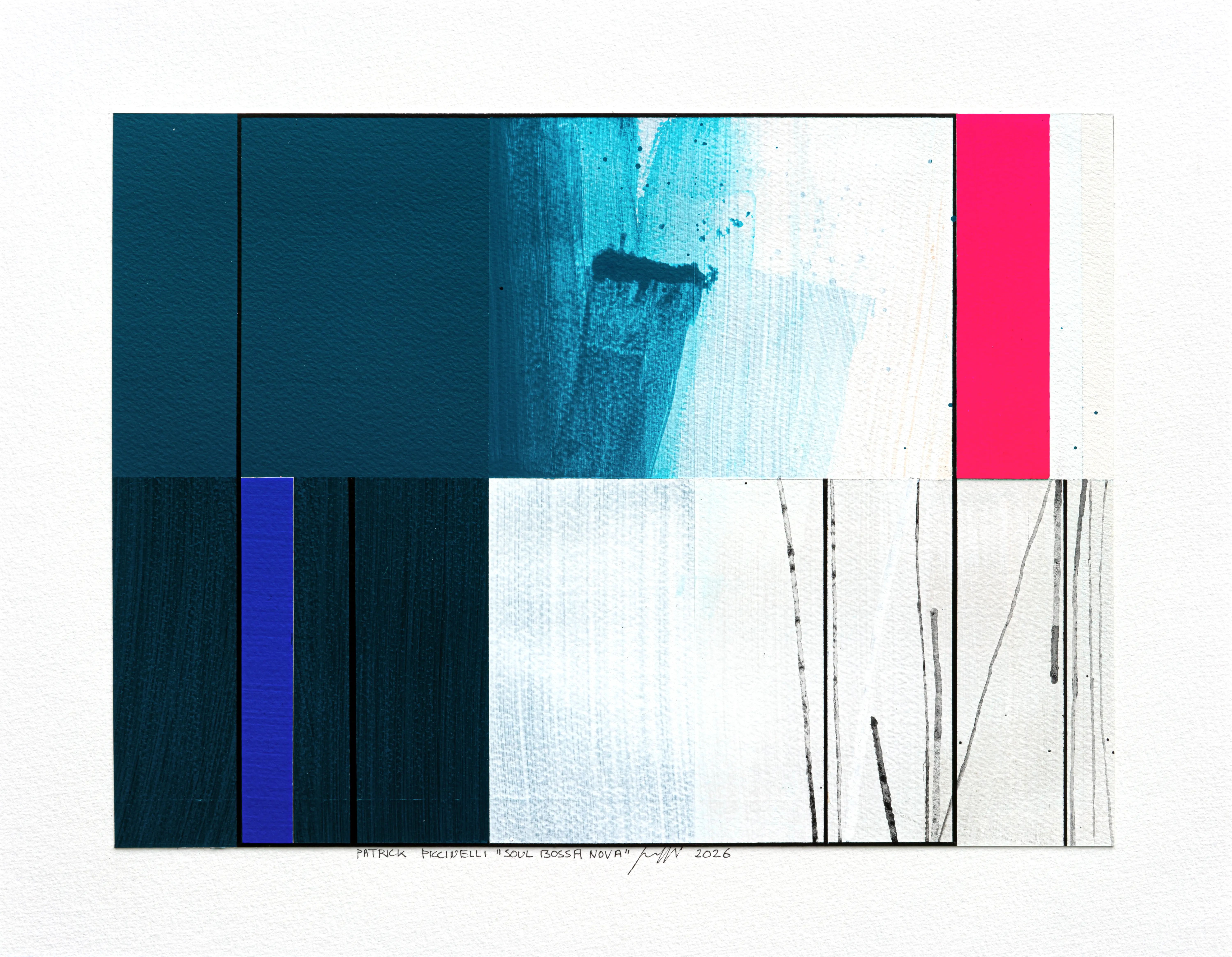
This work, executed in mixed media on paper, constructs a system of vertical bands and blocks of color that, through its very structure, resonates with the musical piece from which it borrows its title.
The Quincy Jones piece is famous for its polyrhythm: the bass and drums articulate a Latin groove while the brass instruments trace almost independent melodic motifs, slightly offset. This superimposition of distinct temporal layers finds a direct visual echo in my composition.
The dark vertical bands of the lower register function as a regular rhythmic pulse, the bass and drums of the piece.
The electric blue band that breaks this regularity introduces a visual syncopation, an unexpected accent, comparable to the rhythmic breaks characteristic of bossa nova. The painted gesture, freer and more gestural, occupying the entire upper register, acts like the floating, improvised, organic melodic line of the brass, contrasting with the metrical rigor of the lower register.
The fluorescent pink functions as a timbral accent, an almost garish splash of color, similar to the punctual and memorable irruption of a solo instrument, the strident flute that made the piece iconic. This pink block, detached from the overall system, acts as an isolated sonic signature within the visual score.
Beyond the formal analogy, the choice of title suggests an attempt at synesthetic translation: transposing into flat planes and pictorial gestures the tension between structure (the grid, the tempo) and freedom (the painted gesture, the improvisation) that defines Quincy Jones's piece, and more broadly, the bossa nova genre, born precisely from this dialogue between rhythmic rigor and melodic fluidity.
Envoyer des commentaires
This work, executed in mixed media on paper, constructs a system of vertical bands and blocks of color that, through its very structure, resonates with the musical piece from which it borrows its title.
The Quincy Jones piece is famous for its polyrhythm: the bass and drums articulate a Latin groove while the brass instruments trace almost independent melodic motifs, slightly offset. This superimposition of distinct temporal layers finds a direct visual echo in my composition.
The dark vertical bands of the lower register function as a regular rhythmic pulse, the bass and drums of the piece.
The electric blue band that breaks this regularity introduces a visual syncopation, an unexpected accent, comparable to the rhythmic breaks characteristic of bossa nova. The painted gesture, freer and more gestural, occupying the entire upper register, acts like the floating, improvised, organic melodic line of the brass, contrasting with the metrical rigor of the lower register.
The fluorescent pink functions as a timbral accent, an almost garish splash of color, similar to the punctual and memorable irruption of a solo instrument, the strident flute that made the piece iconic. This pink block, detached from the overall system, acts as an isolated sonic signature within the visual score.
Beyond the formal analogy, the choice of title suggests an attempt at synesthetic translation: transposing into flat planes and pictorial gestures the tension between structure (the grid, the tempo) and freedom (the painted gesture, the improvisation) that defines Quincy Jones's piece, and more broadly, the bossa nova genre, born precisely from this dialogue between rhythmic rigor and melodic fluidity.
Envoyer des commentaires