Autumn In Warsaw
,
2025
Patrick Piccinelli
Autumn In Warsaw
2025
acrylic paint, walnut stain, ink varnish, mineral pigment on paper.
acrylic paint, walnut stain, ink varnish, mineral pigment on paper.
50
50
X
X
50
50
Available
€
1,400
shipping worldwide included
Add to card
The tension between structure and chaos:
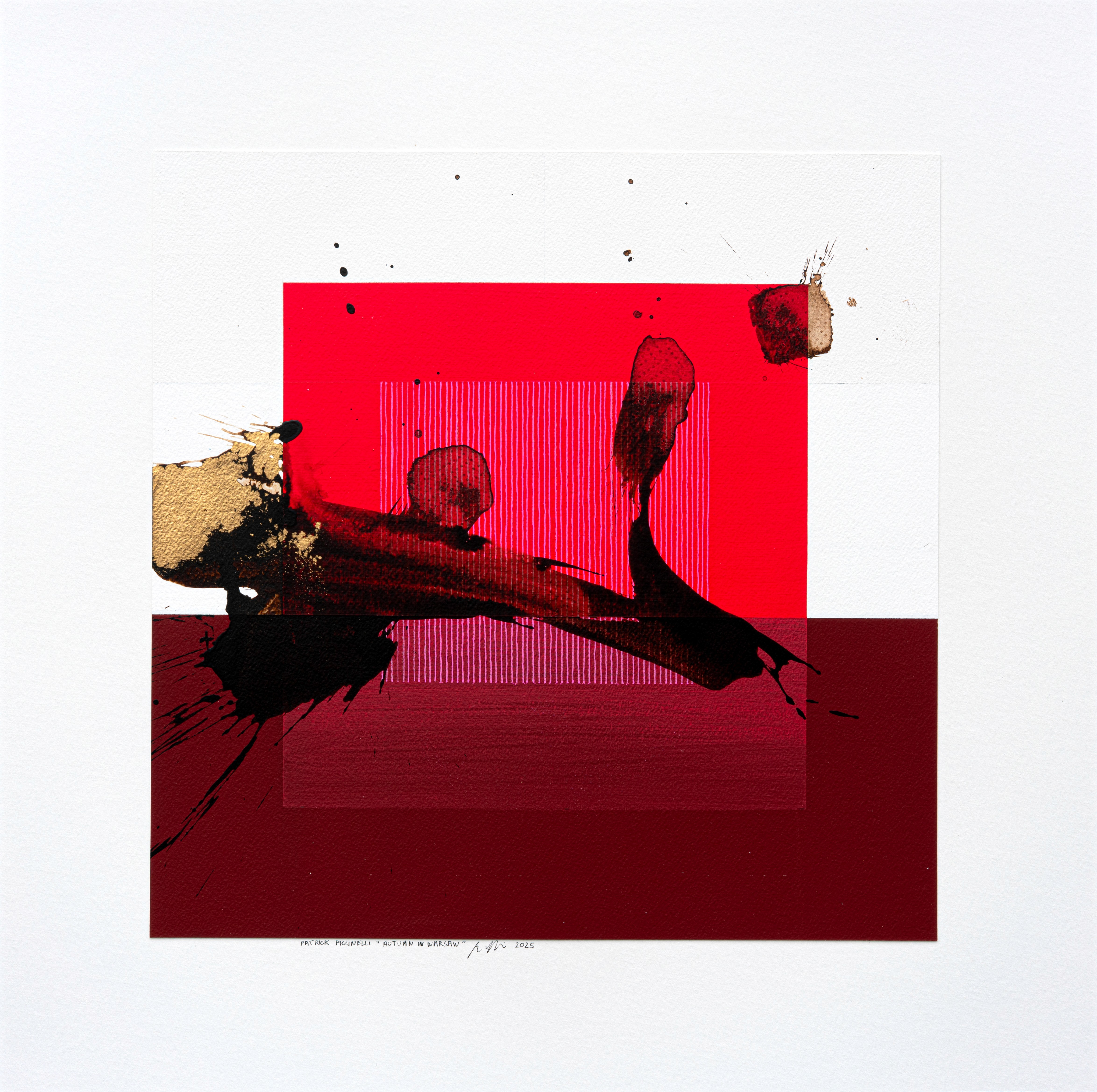
The work rests on a rigorous geometric architecture: two superimposed rectangles, one bright red, the other deep burgundy, evoke the Polish flag and its national two-tone design. This is not a subtle nod, but a deliberate foundation, a flattened topography of identity.
On this ordered surface, a black calligraphic line crosses the composition from left to right, like a severed branch, a gust of wind, or a wound. It does not skirt the geometry; it slashes through it.
Warsaw: A city of visible layers
Warsaw is a city entirely rebuilt on its ruins, a city literally razed and reinvented. The blood red and black of the work are not mere colors; they resonate with a history of violence and rebirth. A work at the crossroads of calligraphy and gestural abstraction:
The central gesture evokes both Far Eastern calligraphy and American abstract expressionism—a sign that seeks to signify something, yet refuses to be legible. Like a language heard but not understood, or a city whose past is perceived but cannot be named.
Autumn in Warsaw is thus a work about the superimposition of time: the cold beauty of a season drawing to a close, of a city that does not forget, conveyed by a gesture that traces without explaining.
The tension between structure and chaos:
The work rests on a rigorous geometric architecture: two superimposed rectangles, one bright red, the other deep burgundy, evoke the Polish flag and its national two-tone design. This is not a subtle nod, but a deliberate foundation, a flattened topography of identity.
On this ordered surface, a black calligraphic line crosses the composition from left to right, like a severed branch, a gust of wind, or a wound. It does not skirt the geometry; it slashes through it.
Warsaw: A city of visible layers
Warsaw is a city entirely rebuilt on its ruins, a city literally razed and reinvented. The blood red and black of the work are not mere colors; they resonate with a history of violence and rebirth. A work at the crossroads of calligraphy and gestural abstraction:
The central gesture evokes both Far Eastern calligraphy and American abstract expressionism—a sign that seeks to signify something, yet refuses to be legible. Like a language heard but not understood, or a city whose past is perceived but cannot be named.
Autumn in Warsaw is thus a work about the superimposition of time: the cold beauty of a season drawing to a close, of a city that does not forget, conveyed by a gesture that traces without explaining.