Mondrian Melancholy
,
2026
Patrick Piccinelli
Mondrian Melancholy
2026
acrylic paint, paint marker on paper, sold without frame
acrylic paint, paint marker on paper, sold without frame
14
14
X
X
14
14
Sold
Private collection:
New Jersey
,
USA
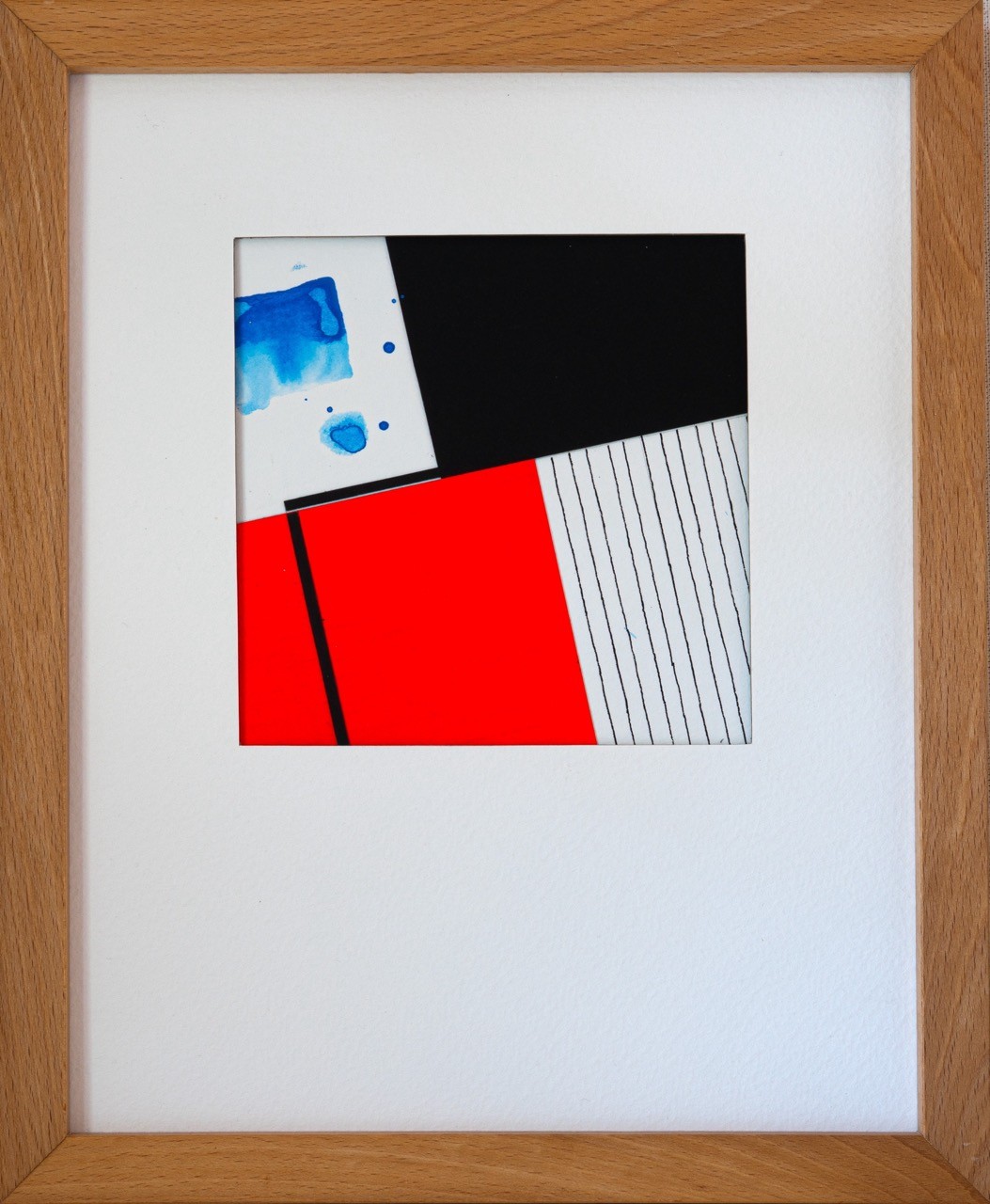
"Mondrian Melancholy," acrylic paint on paper, 14 x 14 cm, 2026.
This small composition establishes a dialogue with the aesthetics of Piet Mondrian, while simultaneously departing from them—a departure that constitutes the subject of the work.
The reference is evident in the construction: blocks of pure color (bright red, black) separated by lines, a geometry that divides the plane into distinct zones, an economy of means reminiscent of Neo-Plasticism. But I allow myself liberties that Mondrian strictly forbade:
The lines are not horizontal/vertical but diagonal, breaking the orthogonal rigor characteristic of the Dutch painter.
A graphic area of slightly irregular lines replaces the pure flatness.
A drip of diluted blue paint, with its uncontrolled splashes, introduces chance and fluidity where Mondrian tolerated only absolute control.
The melancholy arises from this tension between the intended order and its failure. Mondrian's geometric rigor aimed for a universal, almost utopian harmony; here, this harmony is disrupted, as if overtaken by something more human, more fragile.
The diagonals, unlike Mondrian's stable verticals, suggest an imbalance, an instability.
The work questions the limits of the Mondrian ideal: pure geometry is insufficient to contain human emotion. The watercolor stain is the element that "parasitizes" this beautiful, rational structure, as if melancholy were what resists any attempt at absolute order. Mondrian's Cartesian clarity encounters the blurred, the unpredictable, the feeling—in short, everything that Neo-Plastic painting sought to transcend.
But this small work is also a tribute to Mondrian!
"Mondrian Melancholy," acrylic paint on paper, 14 x 14 cm, 2026.
This small composition establishes a dialogue with the aesthetics of Piet Mondrian, while simultaneously departing from them—a departure that constitutes the subject of the work.
The reference is evident in the construction: blocks of pure color (bright red, black) separated by lines, a geometry that divides the plane into distinct zones, an economy of means reminiscent of Neo-Plasticism. But I allow myself liberties that Mondrian strictly forbade:
The lines are not horizontal/vertical but diagonal, breaking the orthogonal rigor characteristic of the Dutch painter.
A graphic area of slightly irregular lines replaces the pure flatness.
A drip of diluted blue paint, with its uncontrolled splashes, introduces chance and fluidity where Mondrian tolerated only absolute control.
The melancholy arises from this tension between the intended order and its failure. Mondrian's geometric rigor aimed for a universal, almost utopian harmony; here, this harmony is disrupted, as if overtaken by something more human, more fragile.
The diagonals, unlike Mondrian's stable verticals, suggest an imbalance, an instability.
The work questions the limits of the Mondrian ideal: pure geometry is insufficient to contain human emotion. The watercolor stain is the element that "parasitizes" this beautiful, rational structure, as if melancholy were what resists any attempt at absolute order. Mondrian's Cartesian clarity encounters the blurred, the unpredictable, the feeling—in short, everything that Neo-Plastic painting sought to transcend.
But this small work is also a tribute to Mondrian!