Pending
,
2025
Patrick Piccinelli
Pending
2025
acrylic paint, collage
acrylic paint, collage
50
50
X
X
65
65
Available
€
1,600
shipping worldwide included
Add to card
Inspired by György Ligeti's musical work "En Suspens"
There is a central piano study in his oeuvre with a semantically very similar and profoundly relevant title: "En Suspens"—the eleventh study in the second book of his Piano Studies (1988–1994). "Pending" is precisely the English translation of "en suspens": that which is pending, suspended, unresolved.
The layering of strata
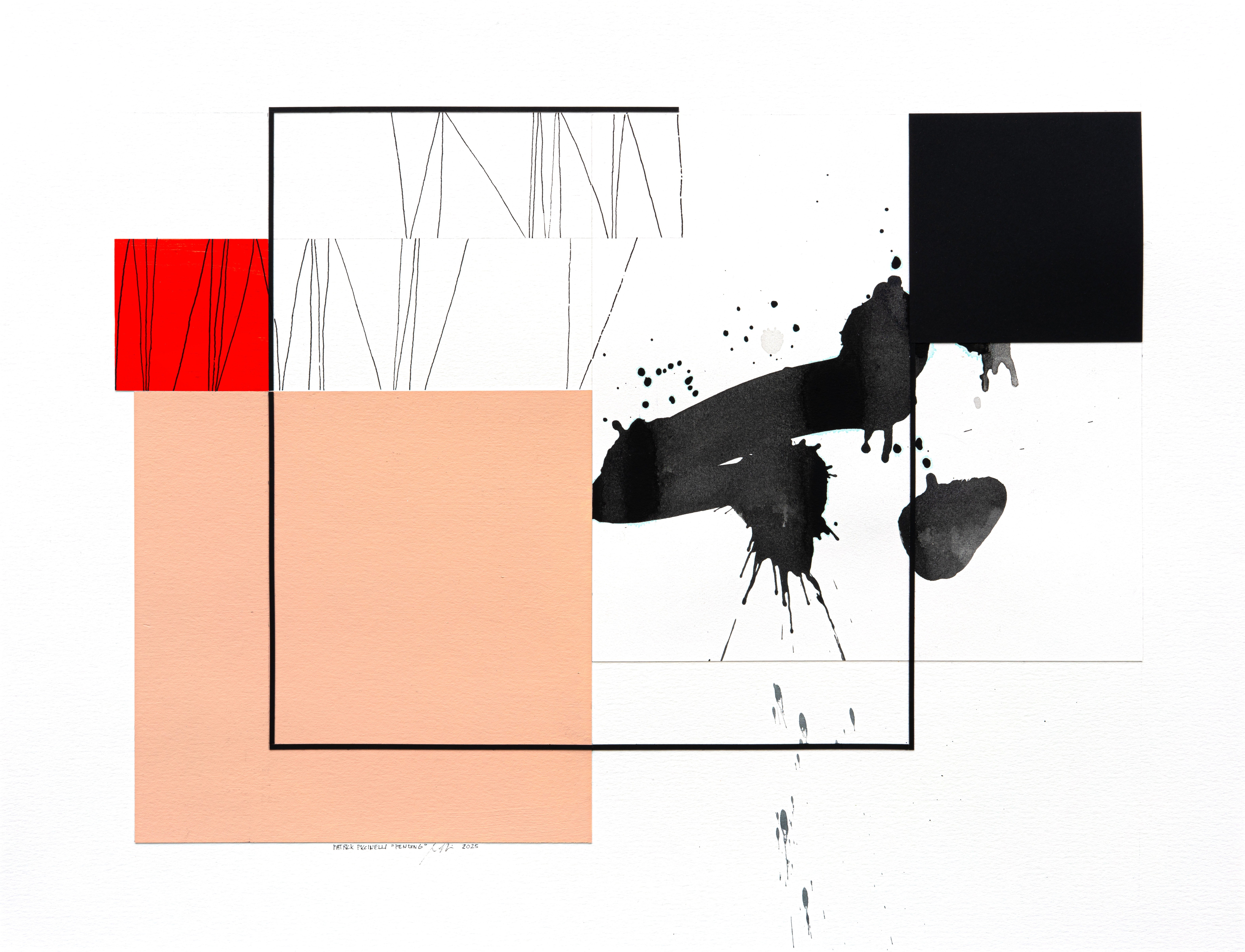
Ligeti's studies are considered one of the great creative achievements of his later decades, combining virtuosic technical challenges with expressive content. In "En Suspens," it is the superimposition of two incompatible beats (6 against 4) that creates this effect of weightlessness. In my composition, it is the material layers—colored paper, sprayed ink, line drawing—that coexist without merging.
The optical/auditory illusion:
Ligeti superimposes rhythms which, with shifted accents and varying speeds, create a third auditory dimension, like an optical illusion. This description applies word for word to the visual work: the splashing ink seems to emerge from a different temporality than the placed and measured rectangles. The painting produces a spatial illusion analogous to Ligeti's rhythmic illusion.
Incompleteness as an aesthetic choice:
"Pending" refers to what is not yet decided. In the painting, the signature in the lower left corner—"Pending" + the date 2026—paradoxically anchors in time a work that refuses closure. The ink splashes still fall toward the bottom of the sheet, beyond the drawn frame. The work overflows its own edge. Ligeti does the same: En Suspens doesn't truly "end"—it fades away, like an interrupted thought.
"Pending," the visual work, and "En Suspens," Ligeti's study, share a common poetics of the threshold: something is being decided, but is not decided. Order coexists with explosion, structure with overflow, waiting with irruption.
Inspired by György Ligeti's musical work "En Suspens"
There is a central piano study in his oeuvre with a semantically very similar and profoundly relevant title: "En Suspens"—the eleventh study in the second book of his Piano Studies (1988–1994). "Pending" is precisely the English translation of "en suspens": that which is pending, suspended, unresolved.
The layering of strata
Ligeti's studies are considered one of the great creative achievements of his later decades, combining virtuosic technical challenges with expressive content. In "En Suspens," it is the superimposition of two incompatible beats (6 against 4) that creates this effect of weightlessness. In my composition, it is the material layers—colored paper, sprayed ink, line drawing—that coexist without merging.
The optical/auditory illusion:
Ligeti superimposes rhythms which, with shifted accents and varying speeds, create a third auditory dimension, like an optical illusion. This description applies word for word to the visual work: the splashing ink seems to emerge from a different temporality than the placed and measured rectangles. The painting produces a spatial illusion analogous to Ligeti's rhythmic illusion.
Incompleteness as an aesthetic choice:
"Pending" refers to what is not yet decided. In the painting, the signature in the lower left corner—"Pending" + the date 2026—paradoxically anchors in time a work that refuses closure. The ink splashes still fall toward the bottom of the sheet, beyond the drawn frame. The work overflows its own edge. Ligeti does the same: En Suspens doesn't truly "end"—it fades away, like an interrupted thought.
"Pending," the visual work, and "En Suspens," Ligeti's study, share a common poetics of the threshold: something is being decided, but is not decided. Order coexists with explosion, structure with overflow, waiting with irruption.