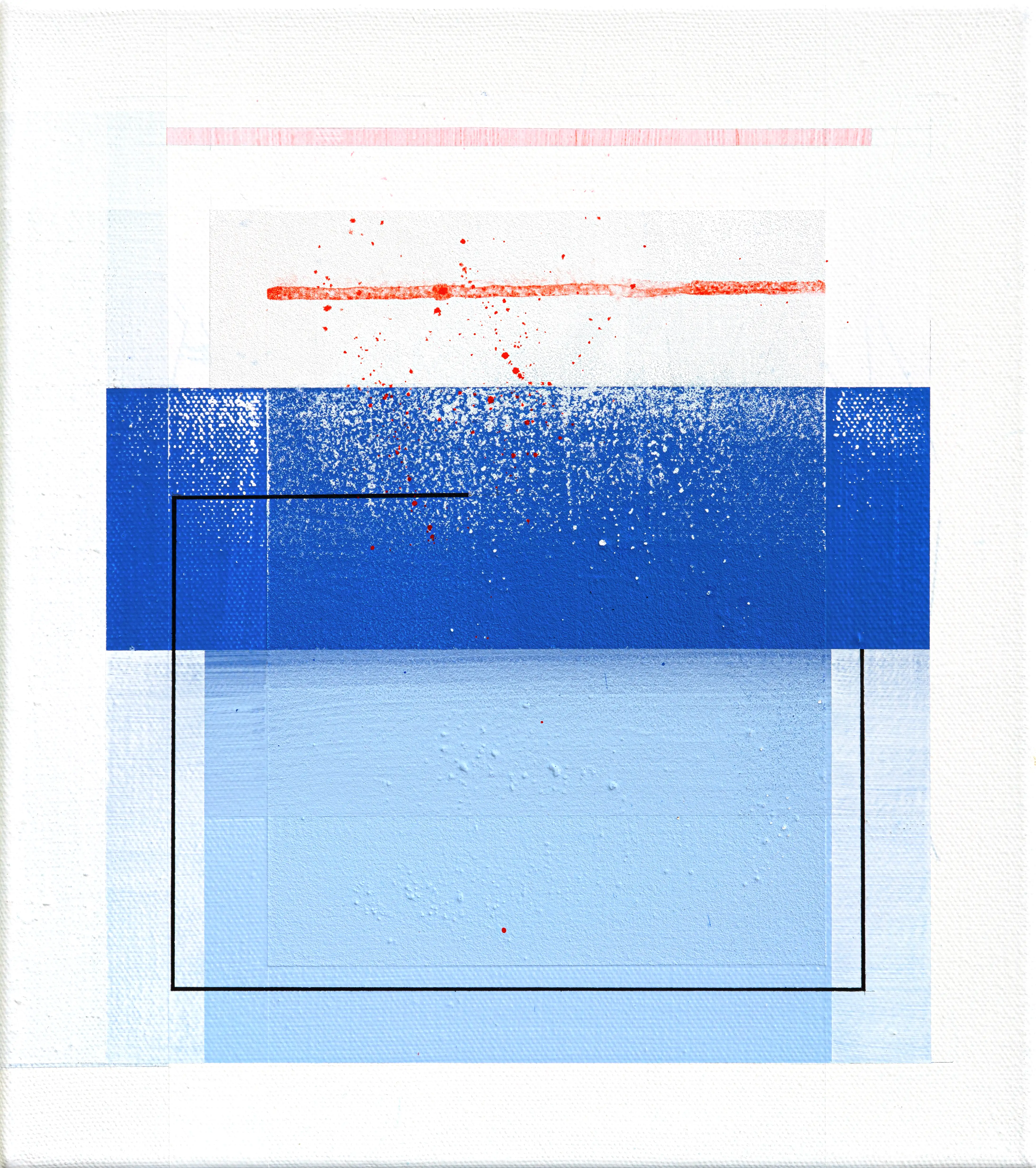
Prayer
,
2026
Patrick Piccinelli
Prayer
2026
acrylic paint, glass particles on canvas, sold without frame.
acrylic paint, glass particles on canvas, sold without frame.
36
36
X
X
32
32
Available
€
1,200
shipping worldwide included
Add to card
The title of this work is inspired by "Prayer" by jazz musician Charles Lloyd.
Prayer, a dialogue between the canvas and the music of Charles Lloyd.
Charles Lloyd's piece "Prayer," the final track on the album Tone Poem (2021, Blue Note), is described as a slow and contemplative composition.
This musical structure, a meditative, almost still background punctuated by bursts of tension and a pleading voice, finds an echo in the construction of the canvas.
The meditative background: the large expanses of blue, worked in gradients and almost atmospheric textures, function like Rogers' bass, a continuous sound without abrupt breaks.
The red line and its splashes, the only touch of bright, gestural color in an otherwise restrained world, acts as the "freer and more dissonant" passage of Lloyd's tenor saxophone, an intensity that pierces the calm surface, almost a wound or a contained cry. Prayer.
Both works, pictorial and musical, share a similar economy of means in service of inner intensity: few elements, great formal restraint, but an emotional charge that emerges through small ruptures, a drop of vermilion, a dissonant note, within an overall serene whole. The title Prayer evokes an invitation to perceive, in the apparent silence of the blue planes, the contained tension that runs through them, just as one listens, in Lloyd's piece, to the supplication surfacing beneath the meditation.
Envoyer des commentaires
The title of this work is inspired by "Prayer" by jazz musician Charles Lloyd.
Prayer, a dialogue between the canvas and the music of Charles Lloyd.
Charles Lloyd's piece "Prayer," the final track on the album Tone Poem (2021, Blue Note), is described as a slow and contemplative composition.
This musical structure, a meditative, almost still background punctuated by bursts of tension and a pleading voice, finds an echo in the construction of the canvas.
The meditative background: the large expanses of blue, worked in gradients and almost atmospheric textures, function like Rogers' bass, a continuous sound without abrupt breaks.
The red line and its splashes, the only touch of bright, gestural color in an otherwise restrained world, acts as the "freer and more dissonant" passage of Lloyd's tenor saxophone, an intensity that pierces the calm surface, almost a wound or a contained cry. Prayer.
Both works, pictorial and musical, share a similar economy of means in service of inner intensity: few elements, great formal restraint, but an emotional charge that emerges through small ruptures, a drop of vermilion, a dissonant note, within an overall serene whole. The title Prayer evokes an invitation to perceive, in the apparent silence of the blue planes, the contained tension that runs through them, just as one listens, in Lloyd's piece, to the supplication surfacing beneath the meditation.
Envoyer des commentaires


