Speechless
,
2026
Patrick Piccinelli
Speechless
2026
acrylic paint, pigment, varnish
acrylic paint, pigment, varnish
50
50
X
X
40
40
Available
€
1,900
shipping worldwide included
Add to card
This work is inspired by the musical track "Speechless" by Enrico Rava.
The title: "Speechless"
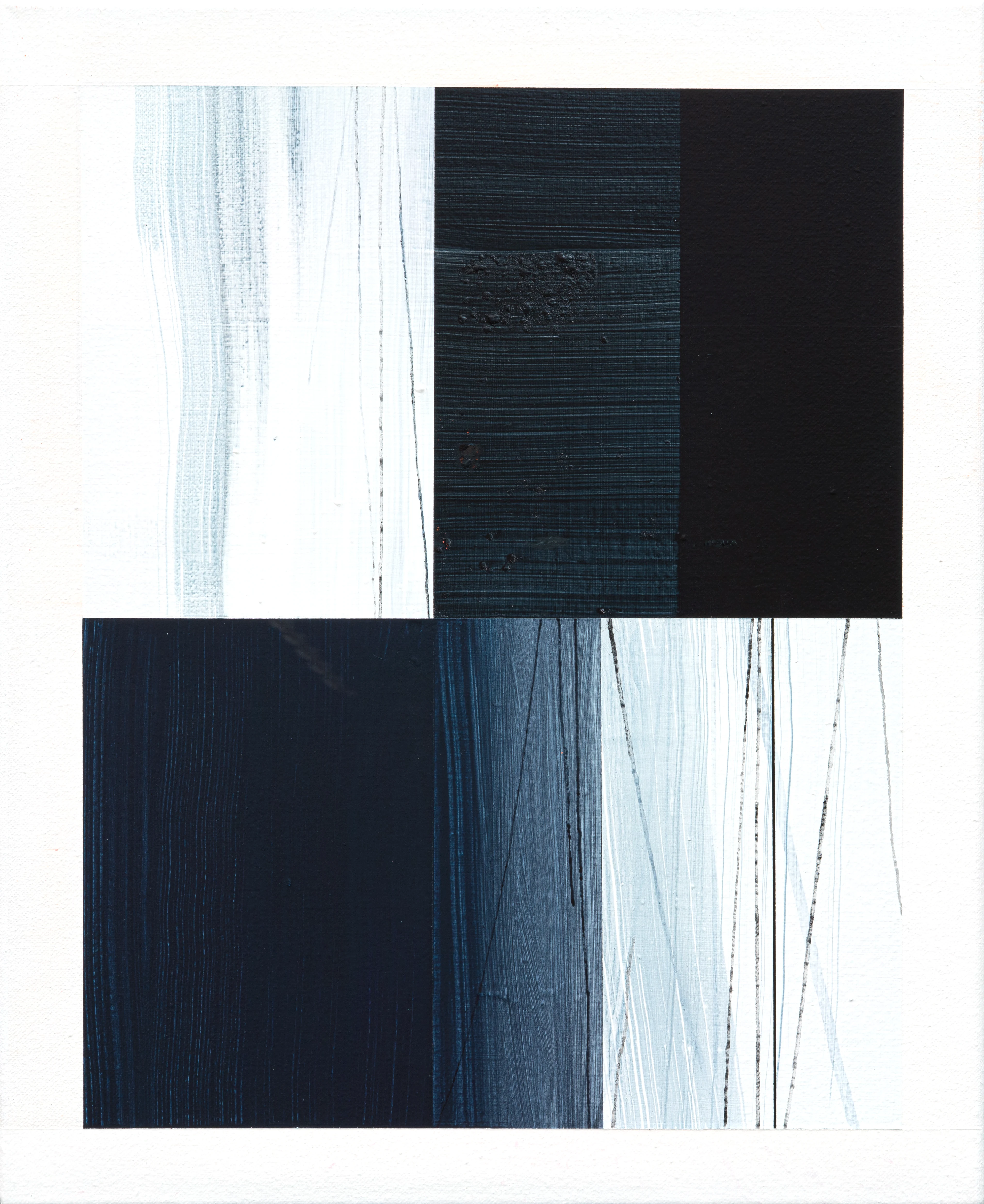
"Speechless" means without a voice, and the canvas gives form to this concept in several ways.
The matte black area on the right is a flat expanse devoid of visible brushstrokes—like words that fail to come.
The white represents a void, a page upon which nothing is said.
The absence of figures leaves the viewer without a narrative to latch onto.
Fine lines express silence as a vibration.
Silence and sound play a significant role in my work. In fact, I dedicated an exhibition titled "Jazz Tracks" to music at the Millennium Art Gallery in Lausanne, and my upcoming exhibition in Geneva will be titled Les Couleurs du Jazz (The Colors of Jazz). I will also mention an exhibition titled "Syncopes/Silences/Rythmes" (curated by Artichoke Festival).
The track appears on On the Dance Floor (ECM, 2012), a live album.
A tribute marked by austerity. The piece is a funeral dedication—sober and understated. The canvas shares this restraint: a palette reduced to black, white, and cool blues. The central black area can be read as mourning, the white as a breath.
The literal meaning of the title: "Speechless" also refers to the emotion that renders one unable to speak. Rava, an instrumentalist, lets the trumpet express what words no longer can. I do the same with the medium itself.
Structure and improvisation. This is the strongest link. Jazz relies on a framework—theme and harmony—that allows for deviation. In my work, the rectangles represent the framework, while the drawn lines, scraped areas, and gradients represent improvisation. Lines that cross the boundaries of the panels act like sustained notes or musical phrases spilling over the measure.
Visual rhythm. The horizontal striations of the central panel contrast with the vertical striations of the others, and the top and bottom panels do not align. The canvas reads like a musical score: dense, dark areas; light, airy passages; a crescendo in the lower gradient; and finally, a resolution into white.
The color of sound. The blues evoke the atmosphere of slow ballads—what English speakers call "blue." The gradient in the central panel can be seen as the swell of a sound emerging from the shadows.
Envoyer des commentaires
This work is inspired by the musical track "Speechless" by Enrico Rava.
The title: "Speechless"
"Speechless" means without a voice, and the canvas gives form to this concept in several ways.
The matte black area on the right is a flat expanse devoid of visible brushstrokes—like words that fail to come.
The white represents a void, a page upon which nothing is said.
The absence of figures leaves the viewer without a narrative to latch onto.
Fine lines express silence as a vibration.
Silence and sound play a significant role in my work. In fact, I dedicated an exhibition titled "Jazz Tracks" to music at the Millennium Art Gallery in Lausanne, and my upcoming exhibition in Geneva will be titled Les Couleurs du Jazz (The Colors of Jazz). I will also mention an exhibition titled "Syncopes/Silences/Rythmes" (curated by Artichoke Festival).
The track appears on On the Dance Floor (ECM, 2012), a live album.
A tribute marked by austerity. The piece is a funeral dedication—sober and understated. The canvas shares this restraint: a palette reduced to black, white, and cool blues. The central black area can be read as mourning, the white as a breath.
The literal meaning of the title: "Speechless" also refers to the emotion that renders one unable to speak. Rava, an instrumentalist, lets the trumpet express what words no longer can. I do the same with the medium itself.
Structure and improvisation. This is the strongest link. Jazz relies on a framework—theme and harmony—that allows for deviation. In my work, the rectangles represent the framework, while the drawn lines, scraped areas, and gradients represent improvisation. Lines that cross the boundaries of the panels act like sustained notes or musical phrases spilling over the measure.
Visual rhythm. The horizontal striations of the central panel contrast with the vertical striations of the others, and the top and bottom panels do not align. The canvas reads like a musical score: dense, dark areas; light, airy passages; a crescendo in the lower gradient; and finally, a resolution into white.
The color of sound. The blues evoke the atmosphere of slow ballads—what English speakers call "blue." The gradient in the central panel can be seen as the swell of a sound emerging from the shadows.
Envoyer des commentaires


